sâmbătă, 22 februarie 2020


The Local Games We Play – For Partner School, Scoala Gimnaziala Vasile Alecsandri, Baia Mare, Romania

Thanking to project coordinator Daniela B. Buda, me ISA coordinator Anil Kr. Yadav (Tyagi Anil Marut) posting about our local game लुकामारी  Lukamari (Hide and seek) game here.

This game is, researched and guided by grade 2 student (Nushrat Khutan) and demonstrated by grade 1 students.  Link of video of  लुकामारी  Lukamari (Hide and seek) under the guidance and instruction of Khutan is here :    

Some more videos and details of local games researched and played by our students in Nepal will be posted soon. We have already got games from Romania students, we will try them out soon and send videos and pictures.

लुकामारी  Lukamari (Hide and seek):
Lukamari (Hide-and-seek) is a old and popular children’s game in Nepal in which one player closes his or her eyes for a brief period (often counting to 100) while the other players hide. The seeker then opens his eyes and tries to find the hiders; the first one found is the next seeker, and the last is the winner of the round. In one of many forms of the game, the hiders try to run back to “home base” while the seeker is away looking for them; if all of the hiders return safely, the seeker repeats as seeker in the next round.
The game is played differently in various regions; sometimes the seeker may be helped by those he finds. Alternatively, only one child hides and is sought by all.
The game is played throughout the world with different name as per our students.

duminică, 16 februarie 2020

Romanian Cultural Heritage Sites

In February 2020, within the partnership with the school from the Anapurna Vidya Sadan Banasthali, Kathmandu - 15, Nepal, my students from grades 3A and 4B studied the Cultural Heritage from Romania, protected by the UNESCO. The information found by my students will be shared with the students from the Nepalese school.

Here are some images from the activity:

ISA PROJECT FOR GLOBAL EDUCATION
2020
ROMANIAN CULTURAL HERITAGE
Grades 3-4
Tudor Pop, grade 3A, from Școala Gimnazială Vasile Alecsandri from Baia Mare, Romania, talking about the discovery of some artefacts dating from the ancient Dacians time. They were found on the property of his great-grandmother in 1986.


Andreea and Ștefania Sălăjan, grade 3A, from Școala Gimnazială Vasile Alecsandri from Baia Mare, Romania, presenting the Cultural heritage sites they found in Romania


ISA Project for Global Education
Cultural Heritage Sites from Romania
Monasteries from Romania
By Andreea and Ștefania Sălăjan, grade 3A, from Școala Gimnazială Vasile Alecsandri from Baia Mare, Romania,  

1.  The Nunnery from Bârsana, is situated in the village with the same name in the County of Maramureș, which lies in the north of Romania.


2.The Monastery from Prislop, is a Romanian monastery, which lies close to the village of Silvasu de sus, in the county of Hunedoara, in the south-west of Romania.


 3.         The “Saint Ana” Monastery from Rohia lies in the “Country of Lăpuș”, in the south of the county of Maramureș, at approx. 50 km away from Baia Mare, the capital of the county. It was built in 1923.


 1.        The Monastery from Nicula, which lies a few kilometers away from the city of Gherla, in the Cluj county, is an important pilgrimage site in the north part of Transylvania, Romania, amongst hills covered by forests. It is famous for the icon of the Mother of God with the baby, icon which is said to make miracles. 


Matia Ilieș, grade 3A, from Școala Gimnazială Vasile Alecsandri from Baia Mare, Romania, presenting the Cultural Heritage sites he found online:


Larisa Krișan and Carina Roman, grade 4B, from Școala Gimnazială Vasile Alecsandri from Baia Mare, Romania, presenting the Cultural Heritage sites they found online:


ISA Project for Global Education

Cultural Heritage Sites from Romania

By Krisan Larisa and Carina Roman, grade 4B, Scoala Gimnaziala Vasile Alecsandri, Baia Mare, Romania


The Danube Delta


The waters of the Danube, which flow into the Black Sea, form the largest and best preserved of Europe's deltas. The Danube delta hosts over 300 species of birds as well as 45 freshwater fish species in its numerous lakes and marshes.


Churches of Moldova:

These eight churches of northern Moldova, built from the late 15th century to the late 16th century, their external walls covered in fresco paintings, are masterpieces inspired by Byzantine art. They are authentic and particularly well preserved. Far from being mere wall decorations, the paintings form a systematic covering on all the facades and represent complete cycles of religious themes. Their exceptional composition, the elegance of the characters, and the harmony of the colors blend perfectly with the surrounding countryside. The interior and exterior walls of the Church of the Suceviţa Monastery are entirely decorated with mural paintings of the 16th century, and this church is the only one to show a representation of the ladder of St John Climacus.


The Monastery of Horezu


 Founded in 1690 by Prince Constantine Brâncovean, the monastery of Horezu, in Walachia, is a masterpiece of the 'Brâncovean' style. It is known for its architectural purity and balance, the richness of its sculptural detail, the treatment of its religious compositions, its votive portraits and its painted decorative works. The school of mural and icon painting established at the monastery in the 18th century was famous throughout the Balkan region.


Villages with Fortified Churches in Transylvania


These Transylvanian villages with their fortified churches provide a vivid picture of the cultural landscape of southern Transylvania. The seven villages inscribed, founded by the Transylvanian Saxons, are characterized by a specific land-use system, settlement pattern and organization of the family farmstead that have been preserved since the late Middle Ages. They are dominated by their fortified churches, which illustrate building styles from the 13th to the 16th century.


Bibliography:


The Games We Play - partnership with Nepal

In February 2020, my students from grade 2A researched and demonstrated some of the games they play in their spare time. These games will be sent to our partners from the Anapurna Vidya Sadan Banasthali, Kathmandu - 15, Nepal. When we get the games from our Nepalese friends, we will try them out. Here are so me of the games we are sending them:

ISA PROJECT FOR GLOBAL EDUCATION
2020
ROMANIAN GAMES


ICE CAT (Romanian title: "Mâță gheață")

This game is played outside by a larger group of children. The “cat” is chosen by the children after using a certain little poem to choose. They keep their fists closed and one of them recites the poem touching each child’s fists for each syllable of the poem. (example:” From the Pacific Ocean a small fish came out and, on its tail, it was written that YOU should get out.”). The last child to remain is the “cat”. The CAT chases the other children. The child who has been touched by the cat freezes (that means he/she cannot move) until other children touch him/her to defrost him/her (then he/she can move again). If the frozen child is not touched by anyone within 10 seconds, he/she is out of the game and becomes the CAT in the next round of the game.
(Informers: Indre Andrei, Ștef Alex and Alex Barbul, grade 2A, Școala Gimnazială “Vasile Alecsandri”, Baia Mare, Romania)

(The game in the video.)


Colored CAT (Romanian title: "Mâță colorată")

This game is played outside by a larger group of children. The “cat” is chosen by the children after using a certain little poem to choose. They keep their fists closed and one of them recites the poem touching each child’s fists for each syllable of the poem. (example:” From the Pacific Ocean a small fish came out and, on its tail, it was written that YOU should get out.”). when one of the fists of any child is touched last in the numbering, he/she puts that fist behind him/her and the numbering continues. The child whose last fist remains un-numbered is the “cat”. The CAT chases the other children. The children say a color when the CAT tries to touch them, but they mustn’t say the same color. If the CAT touches any child before saying a color, that child becomes the CAT.
(Informer: Gabriel Coteț, grade 2A, Școala Gimnazială “Vasile Alecsandri”, Baia Mare, Romania)


The LASER(Romanian title: "Laser")

This game can be played outdoors or indoors. The LASER holds his/her hand horizontally and tries to touch other players with his hand. The other players stay each in one place and are not allowed to run, but they can bend down or rise up top avoid the LASER touching them. The first player touched by the LASER becomes the LASER.
(Informant: Lucas Indrecan, grade 2A, Școala Gimnazială „Vasile Alecsandri”, Baia Mare, Romania)

The Pheasant (Romanian title: "Fazan")

It’s an indoors game played by any number of children. One of them says the alphabet in his/her mind and other child says Stop. The child thinking the alphabet stops and has to say the letter he/she has got to. The next player has to say a word starting with that letter. The next player has to say a word starting with the last syllable of the last word spoken before him/her. When a player cannot say a word starting with the last syllable from the last word, that player gets an “P” (from the words “Pheasant”). The player who get the whole word “Pheasant” gets out od the game. The game ends when most of the players get the “Pheasant” word.
(Informer: Lucas Indrecan, grade 2A, Școala Gimnazială „Vasile Alecsandri”, Baia Mare, Romania)


DUCKS AND HUNTERS 
(Romanian title: "Rațele și vânătorii")

It’s an outdoors game played by minimum 4 players. Two hunters are chosen, and the other players are the ducks. They draw on the ground the playing space as a rectangle. One hunter stays in each end of the rectangle. They are not allowed to enter the rectangle. The HUNTERS must throw the ball to touch the ducks who can run within the rectangle. The Ducks must try not to get hit by the ball. When a Duck gets hit by the ball, it exits the game. If they get out of the rectangle without being hit by the ball, they are out of the game. The last Duck in the rectangle must be hit as many times as its age (e.g.: if the child is 8, he/she must be hit 8 times.)
(Informer: Darius Man and Alex Barbul, grade 2A, Școala Gimnazială „Vasile Alecsandri”, Baia Mare, Romania)


The Blind Old Woman
(Romanian title: "Baba oarba")

This game can be played indoors or outdoors by as many players as they want. One player’s eyes are blinded with a scarf, is turned around 4 times and then “The Blind Old Woman” has to catch other players. The player who is caught, becomes the Blind Old Woman.
(Informer: Iulia Nechita, Alisia Cirț and Natalia Danci, grade 2A, Școala Gimnazială „Vasile Alecsandri”, Baia Mare, Romania)


The Dinosaurs (Romanian title: "Dinozaurii")

This game can be played indoors or outdoors by minimum 3 players. The DINOSAUR is chosen from amongst the players. The DINOSAUR chases the other players and has to catch and eat them. The player who is caught by the DINOSAUR goes to his side. The game ends when the DINOSAUR catches all the other players.
(Informer: Iulia Nechita, Alisia Cirț and Natalia Danciu, grade 2A, Școala Gimnazială „Vasile Alecsandri”, Baia Mare, Romania)

HIDE AND SEEK
(Romanian title: "Tupu" or "De-a vați ascunselea")

This game can be played indoors or outdoors by at least 3 players. One player closes his/her eyes facing a wall and numbers loudly up to 30. The other players hide in places from where they can see the Seeker, but the seeker can’t see them. The SEEKER must find the players hiding. The first player that the SEEKER finds becomes the SEEKER.
(Informer: Iulia Nechita, Alisia Cirț and Natalia Danci, grade 2A, Școala Gimnazială „Vasile Alecsandri”, Baia Mare, Romania)


TRUTH OR DARE
(Romanian title: "Adevăr sau provocare")

This game can be played indoors or outdoors. The players sit down and one of them asks another player if he/she chooses Truth or Dare. If the player chooses Truth, he/she is asked a question and he/she has to answer with a truth. If the player chooses Dare, he/she has to perform the daring action the group ask the player to do.
(Informer: Iulia Nechita, Alisia Cirț and Natalia Danci, grade 2A, Școala Gimnazială „Vasile Alecsandri”, Baia Mare, Romania)


Preparing the Cultural Box for Taiwan

In February 2020, we prepared to send the Romanian Culture Box to our friends from the Chongqing Junior High School, from New Taipei City, Taiwan:


We got the Cultural Box from Taiwan

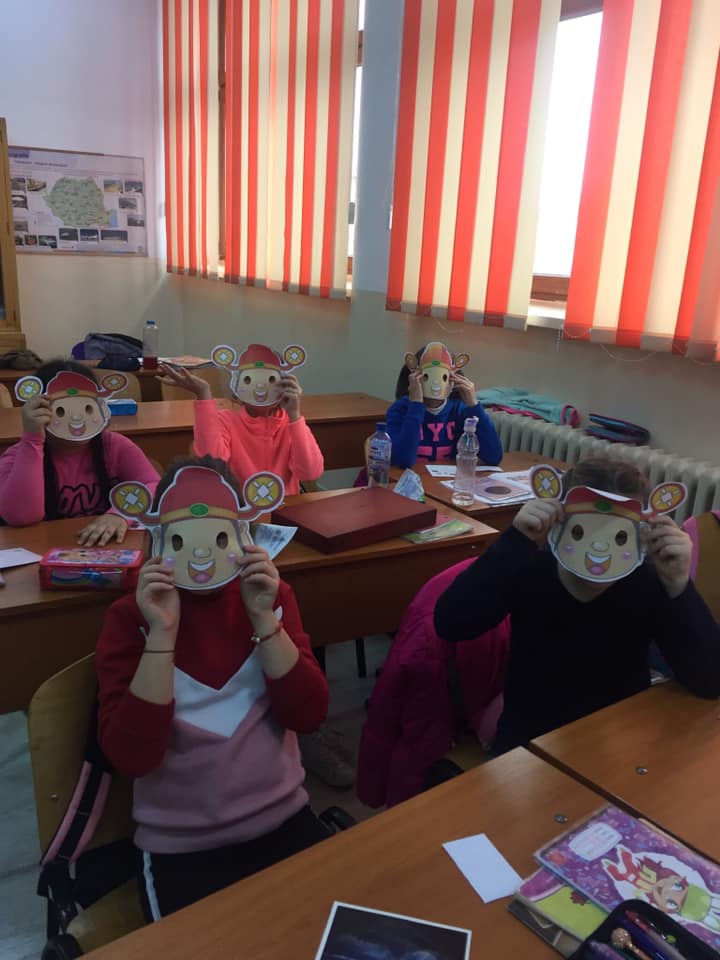
In January, we got the Cultural Box from our partners from the Chongqing Junior High School, from New Taipei City, from Taiwan.